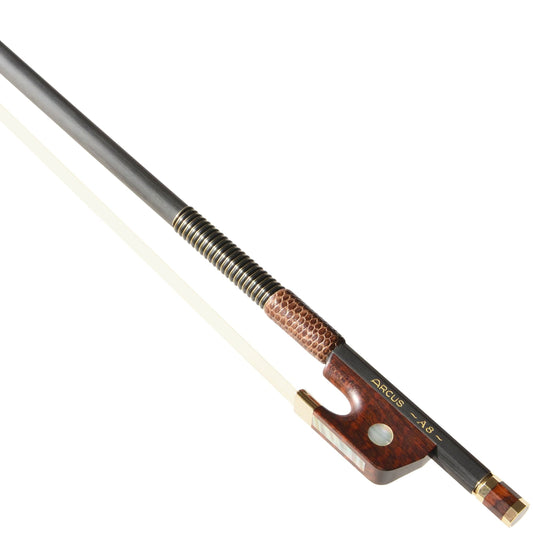
Collection: Carbon Fiber Violin Bows Arcus/Muesing

Carbon Fiber Violin Bows – ARCUS and Müsing

Both brands come from the same workshop in Würzburg, Germany — Bernd Müsing KG — and share a core conviction: that high-density carbon fiber makes a violin bow possible that delivers what pernambuco wood, physically, no longer can — in sound, playability, and durability. Beyond that shared foundation, they pursue two distinct approaches aimed at different players.

What they have in common: the sticks are hollow, with a wall thickness under one millimeter and a resin content well below the market average for conventional carbon fiber bows. This allows freer vibration than solid wooden sticks, significantly higher sound transmission speed, and — immediately audible — a bigger, clearer tonal image with a wider dynamic range. Both are completely climate-proof, never lose their camber, and are robust enough for col legno that the stick takes no damage. The stick carries a 30-year warranty.

The natural resonance frequency of these sticks sits at approximately 100 Hz — a full octave above classical wooden bows at around 50 Hz. This difference lies outside the frequency range that causes fatigue and discomfort in the hand, arm, and shoulder of many professional players. If you experience such problems with a conventional bow, it is worth scheduling a trial day.

ARCUS Violin Bows – why a carbon fiber bow can cost €12,000

ARCUS says it without hesitation: the T9 is "probably the finest bow ever made by human hand." That is not a marketing claim — it is the logical consequence of what happens during production.

A wooden bow — no matter how old, no matter how expensive — is limited by its material. Pernambuco is the best wood bow makers have found over centuries. But wood fatigues, reacts to humidity, varies unpredictably in its properties, and hits a structural ceiling in stiffness and vibration transfer. With high-density carbon fiber, that ceiling does not exist in the same way. A thin-walled, hollow carbon fiber stick vibrates more freely, transmits vibrations faster, and never loses these properties — neither through use nor through time.

The price of an ARCUS bow is not driven by positioning but by selection. After curing, every stick is individually tested acoustically. The internal fiber structure — its precise orientation and distribution — cannot be fully controlled during manufacturing. The outcome varies considerably. Most sticks become lower models, a smaller number reach the middle grades, and only a very small fraction passes the criteria for grade 8 and 9. A T9 or S9 Gold is literally the best out of a very large quantity — and its price reflects that.

The number in the model name (4 through 9) is not an arbitrary hierarchy but the direct result of this grading. A T6 or S6 matches the tonal level of the finest old pernambuco bows — the kind that fetch five- and six-figure sums at auction and are simply out of reach for most musicians. From grade 7 onward, ARCUS operates in territory where no wooden bow equivalent exists: not as a matter of opinion, but because wood as a material stops there.

What this means in practice, musicians describe in remarkably similar terms: the response changes — even in pianissimo, the tone is there instantly, without pressure. The bouncing is even across all strings. Double stops emerge with a clarity you didn't know was possible. And the dynamic spectrum opens up so far that you discover capabilities your instrument had never shown before. Most players who have tried a higher-grade ARCUS don't go back.

ARCUS offers several series for violin, each with a distinct tonal character and instrument pairing:

T Series — the best-selling series worldwide. Ideally balanced sound: brilliant and radiant, yet full, round, and warm. Suits violins with normal elasticity and a balanced to bright character. Round stick. Weight approximately 51 g. Models T4 through T9.

S Series — for violins with a warm or dark tonal character. The S bows bring more brilliance, projection, and clarity into the sound without making it harsh. Available with round stick (steadier, more stable) or octagonal stick (more agile, very lively). Weight approximately 49 g. Models S4 through S9. A note on strings: combinations with strongly focused strings such as Pirastro Evah Pirazzi green, Jargar Evoke, or Thomastik Vision Titanium Solo are not recommended — they narrow the tonal image. Proven pairings include Thomastik Rondo, Larsen Il Cannone, and Jargar Superior.

If your violin leans dark or warm, the S Series is the natural choice. If it sounds balanced or bright, the T Series.

Müsing Violin Bows – C Series and L Series

Müsing is the same technology, a different philosophy. No grading numbers in the upper solo range, no gold fittings — instead, a clear focus on what actually matters to most musicians day to day: a bow that simply works. One that bounces when it should, stays on the string when it should, and lets you play without having to think about the bow.

C Series — the pernambuco replacement for anyone who wants to stay close to the sound of a fine wooden bow. Approximately 55 g, spring tension about 50% above average for comparable carbon fiber bows. The bow sits absolutely securely on the string, never collapses even in fortissimo, and bounces well. The sound is very close to that of a good wooden bow — perhaps slightly clearer, because the hollow stick produces less bow noise. Every C Series stick is individually graded as well: the C2 clearly outperforms standard carbon fiber bows, the C3 rivals many master bows, the C4 and C5 go further. Fittings from stainless steel upward, frog in ebony or snakewood.

L Series — lighter, more agile, richer in tonal color. The aluminum tip serves as a deliberate counterweight: the bow weighs approximately 51–52 g — on par with Classical and Baroque bows — yet has the spring tension of a viola bow. The stick vibrates more freely than the C Series, and the sound goes beyond what wooden bows achieve: more open, clearer, more colorful. L3 through L6, each individually graded. According to the manufacturer, the L5 and L6 are competitive for any style and any occasion.

The C and L Series differ not only in weight but in tonal approach: if you are looking for the character of a wooden bow, well made and more durable, choose the C Series. If you want more color, openness, and agility — and are willing to leave the wooden-bow reference behind — you will find it in the L Series.